Moped License and Permit Rules in the United States
Do you need a license to ride a moped in the United States?
In Germany, a small moped can be ridden with a special moped test certificate. In the United States, there is no single nationwide equivalent to the German Mofa-Prüfungsbescheinigung. Moped rules are set mainly by the individual states, which means that licensing, minimum age, registration, insurance, helmet rules, and road-use rules can differ significantly.
In many U.S. states, a small moped or motorized bicycle is usually defined by a combination of engine size and speed. A common pattern is an engine of 50cc or less and a maximum speed of around 30 mph on level ground. However, this is only a general orientation. Some states use different definitions, different speed classes, or different legal terms.
For U.S. readers, the most important point is simple: there is no universal “moped certificate” for the entire country. The correct rule depends on the state where the vehicle is operated.
Minimum age and driver license requirements
In the United States, mopeds are usually not treated as bicycles in the same way as ordinary pedal bikes. Most states require at least some kind of legal driving privilege. Depending on the state, this may be a regular driver license, a learner permit, a moped permit, or a motorcycle endorsement.
The minimum riding age is often between 14 and 16 years, but this varies by state. Some states allow younger riders under special moped rules, while others require the rider to be old enough to hold a regular driver license or learner permit.
Unlike the German rule where people born before a certain date may ride a moped without the certificate, U.S. rules usually do not follow that kind of birth-date exemption. If a state requires a license, permit, registration, or insurance, the requirement normally applies according to the state’s current vehicle code and DMV rules.
What happens if a driver license has been suspended?
In Germany, a person whose regular driving license has been withdrawn may in some cases still be allowed to ride a moped if only the license has been withdrawn but no separate driving ban applies. In the United States, this situation is usually stricter and more state-dependent.
If a person’s driver license has been suspended or revoked, riding a moped may also be illegal if that state requires a valid driver license or permit for moped operation. In some states, a moped-specific permit may exist, but this does not automatically mean that a person with a suspended license may legally ride. A suspension, DUI restriction, court order, or administrative driving ban can also affect mopeds and motorized bicycles.
For that reason, anyone with a suspended or revoked license should check the exact state rule before riding a moped on public roads.
Training, written tests, and permits
In Germany, a moped certificate can be obtained through driving schools and, in some federal states, through school-based traffic education. The training includes theory, some practical riding exercises, and a written test. There is no full practical road test like for a regular driver license.
In the United States, there is no standard national moped course that works the same way everywhere. Some states require only a regular driver license. Some allow a learner permit. Others require a moped license, a motorcycle permit, or a motorcycle endorsement, especially if the vehicle is faster or more powerful than a low-speed moped.
Where a written test is required, it usually covers traffic signs, right-of-way rules, safe riding behavior, road positioning, speed limits, alcohol and drug rules, helmet requirements, and basic vehicle operation. A practical test may or may not be required depending on the state and the vehicle class.
Therefore, instead of one national moped test certificate, U.S. riders usually have to follow the requirements of their state DMV or motor vehicle agency.
Registration, license plate, and insurance
In Germany, a moped needs a yearly insurance plate. These plates change color every year and show that the vehicle is insured for that insurance period.
In the United States, this system does not exist in the same form. Many states require mopeds to be registered and to display a license plate or special moped plate. Some states require insurance, while others do not require insurance for certain low-speed mopeds or motorized bicycles. In some states, registration and insurance depend on whether the vehicle is classified as a moped, motorized bicycle, motor-driven cycle, limited-use motorcycle, scooter, or motorcycle.
A vehicle that goes faster than the moped limit or has a larger engine may be treated as a motorcycle. That can trigger stricter requirements, including motorcycle registration, insurance, and a motorcycle license or endorsement.
Examples of different state rules
California treats motorized bicycles and mopeds as a specific vehicle category. If a moped is modified so that it can exceed 30 mph, it may be treated as a motor-driven cycle or motorcycle for registration purposes.
Florida distinguishes between mopeds, motorcycles, motorized scooters, and micromobility devices. Small stand-up motorized scooters are treated differently from sit-down mopeds or scooters, and the licensing and registration rules are not identical.
New York uses the term limited-use motorcycle and divides mopeds into classes by top speed. The class affects whether a motorcycle license or regular driver license is required and what registration rules apply.
These examples show why a single U.S. rule would be misleading. The same-looking 50cc scooter may be treated differently depending on the state.
Legal road use
Mopeds are normally intended for local roads and short-distance travel. They are generally not permitted on highways or roads where minimum speed rules make them unsuitable. Their legal use on bike lanes, bicycle paths, sidewalks, or trails depends heavily on local and state rules.
In many places, mopeds must be operated on the road with other traffic, not on sidewalks. Some states or cities may allow certain electric scooters or low-speed devices in bike lanes, but this does not automatically apply to gasoline-powered mopeds or 50cc scooters.
What riders should check before riding
Before riding a moped or motorized bicycle in the United States, a rider should check the state’s current rules for the following points:
Minimum age, driver license or permit requirement, motorcycle endorsement requirement, registration, title, license plate, insurance, helmet requirement, maximum allowed speed, maximum engine size, passenger rules, road-use restrictions, and whether local city rules add further limits.
This is especially important for imported mopeds, modified mopeds, older two-stroke vehicles, and electric vehicles, because their classification may not be obvious from appearance alone.
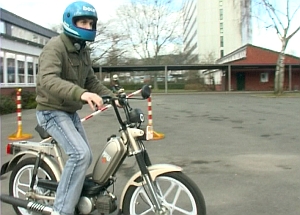
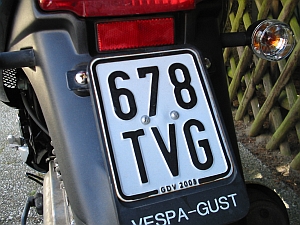
The German moped test certificate is a clearly defined national concept. The United States does not have one single equivalent. Instead, moped riders must follow state-specific rules.
In many states, a low-speed moped is limited to around 50cc and 30 mph, but licensing, registration, insurance, and minimum age requirements vary. Anyone planning to ride a moped in the United States should check the current DMV rules of the state where the vehicle will actually be used.